
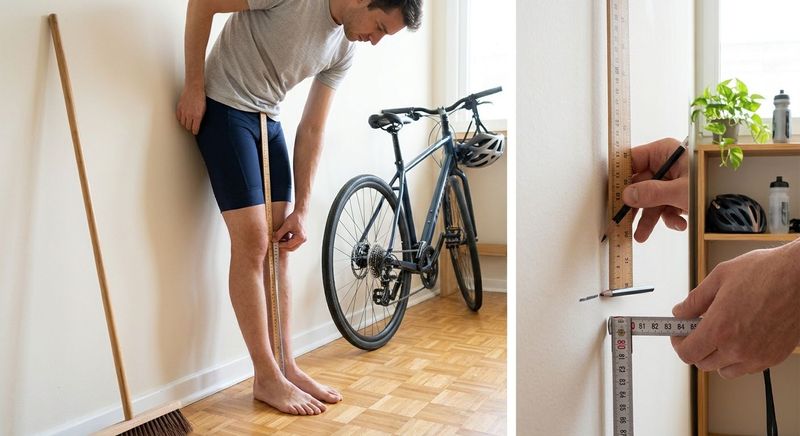
What you need:
- A stick (or a broom handle / a level),
- a tape measure and a pencil.
How to measure:
- Stand barefoot, with your legs straight and wearing tight-fitting clothing (e.g. shorts), with your back firmly against a wall.
- Insert the stick between your legs, keeping it parallel to the floor, and lift it from the bottom up, sliding it close to the wall until it simulates the pressure of the saddle.
- When you reach the intersection of the lower limbs (the crotch), keep the stick still, turn around and mark with the pencil the exact point where the tip of the stick touches the wall.
- Take the tape measure and measure the distance in centimeters between the mark on the wall and the floor: this is your inseam measurement.
Adjusting the Saddle Height (Practical Method / Hinault)
Once the inseam measurement has been established, all other adjustments (saddle height, setback, handlebar reach) depend on it. To calculate the correct saddle height (measured from the center of the bottom bracket to the top of the saddle along the seat tube):
The reference calculation: Multiply the inseam measurement by the coefficient 0.885 (Hinault Method).
Example: If your inseam is 80 cm ----- 80 x 0.885 = 70.8 cm saddle height.
⚠️ ATTENTION TO THE SAFETY OF THE SEAT POST
If the seat height adjustment requires you to extend the seat tube significantly from the frame: Make sure you never exceed the "MIN INSERT" mark engraved on the seat tube. If the seat tube extends too far beyond that limit, your bike frame size is too small for you; you will need to use a longer seat tube to stay within safety margins and avoid structural failure.